Issue Tracking · Wiki · Goal BI
One Operating System
for growing teams and AI
GoalTrack compresses issue tracking, a team wiki, and goal-driven BI into one operating system. People and AI agents work from the same goals, the same context, and the same metrics.
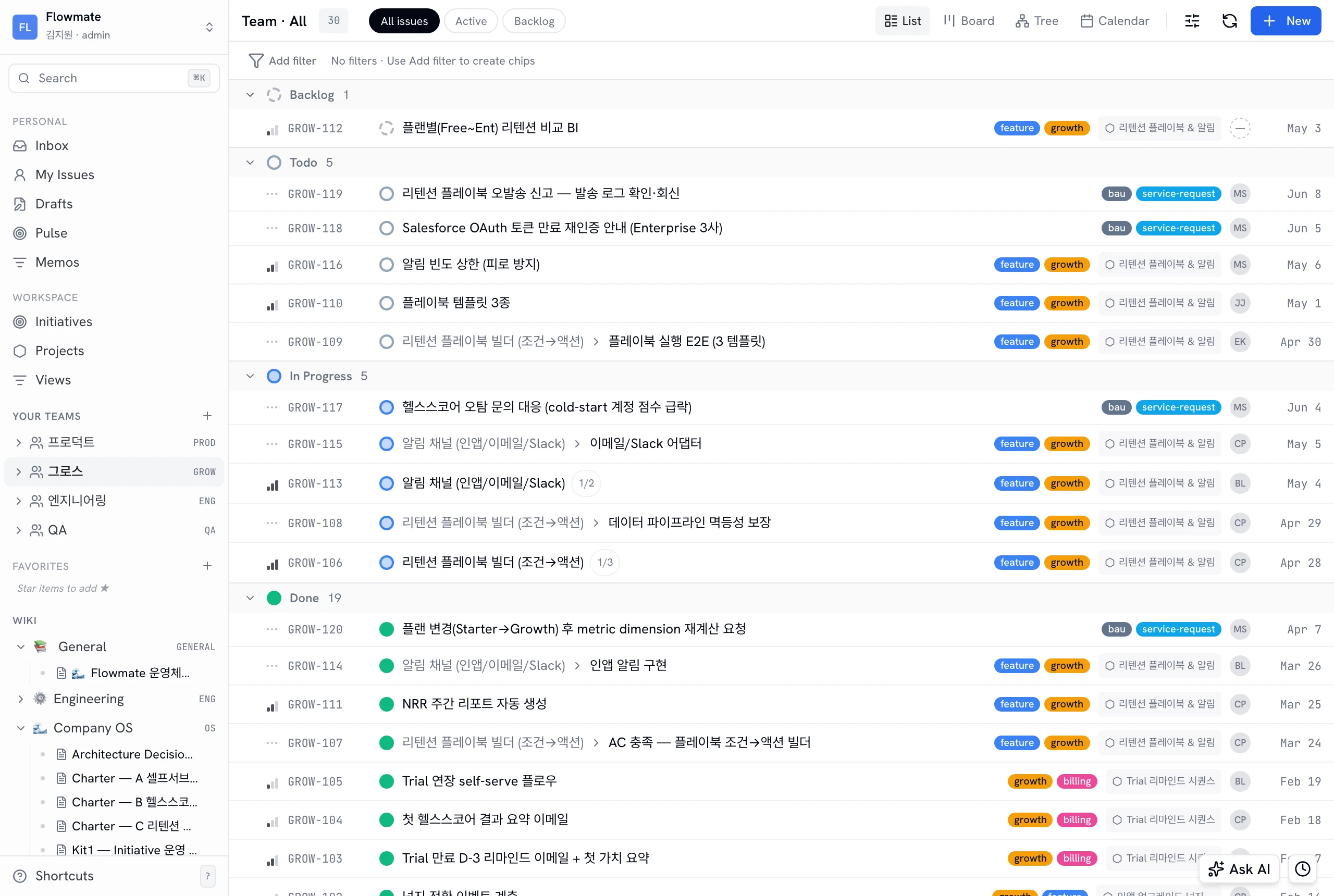
Issues are the work. Wiki is the context. Metrics are the proof. Work once split across three subscriptions now runs in a single execution loop.
The Problem
More people,
and somehow slower
Go from 7 people to 20 and communication paths explode from 21 to 190. Goodwill and overtime can't absorb it — this is where a problem of structure begins.
“Decided once,
decided again.”
With no single source of truth, decisions scatter across chat and evaporate. Zombie meetings re-litigate what was already settled.
“Handed off,
but no owner.”
Each team's output is clear, but no one owns the whole result end to end. Gray zones pile up.
“Done,
then redone.”
Every team defines ‘done’ differently. Reopens and hotfixes repeat, and trust between teams erodes.
Growing pains aren't about attitude — they're about structure. The answer isn't ‘try harder,’ it's rules, records, and standards.
Philosophy
When the goal is clear,
teams move on their own
GoalTrack grew out of launching products with dozens of teams and watching growing startups struggle up close. One thing held true every time — the teams that won weren't the ones a founder micromanaged, but the teams whose members executed toward a goal on their own and produced results.
An Initiative that defines the one thing this quarter, an Epic Charter that fixes the why and the scope, and a DoD that agrees on ‘done’ in advance. When the goal and the definition of done are clear, the people doing the work decide for themselves.
A Pipeline that defines the path value flows through, a WIP policy that controls what gets started, and Gates you can't skip. When the path is visible, the next task reveals itself — no one has to assign it.
Every piece of work at every stage carries exactly one name. When ‘my work’ is unambiguous, gray zones disappear, and even as people change, someone remains accountable for the result to the end.
And then, AI happened
When the goal is clear, when there's agreement on what ‘done’ means, and when the context is preserved — people and AI alike produce good results on their own.
Performance = Objective × Eval × Context
If any one term is zero, the result is zero.
Human organizations can approximate their way through with tacit knowledge even when all three are blurry. AI cannot: without clear objectives, evaluation, and context, it simply doesn't work well. The structure that's ‘the best to work in’ for a human team is ‘the only structure that works’ for an AI agent.
GoalTrack turns that principle into a product — a place where goals are recorded, definitions of done are agreed, and flow is measured. An operating system built for anyone who moves by goals, human or AI, to work well on their own.
Product
Execution, context, and proof
in one loop
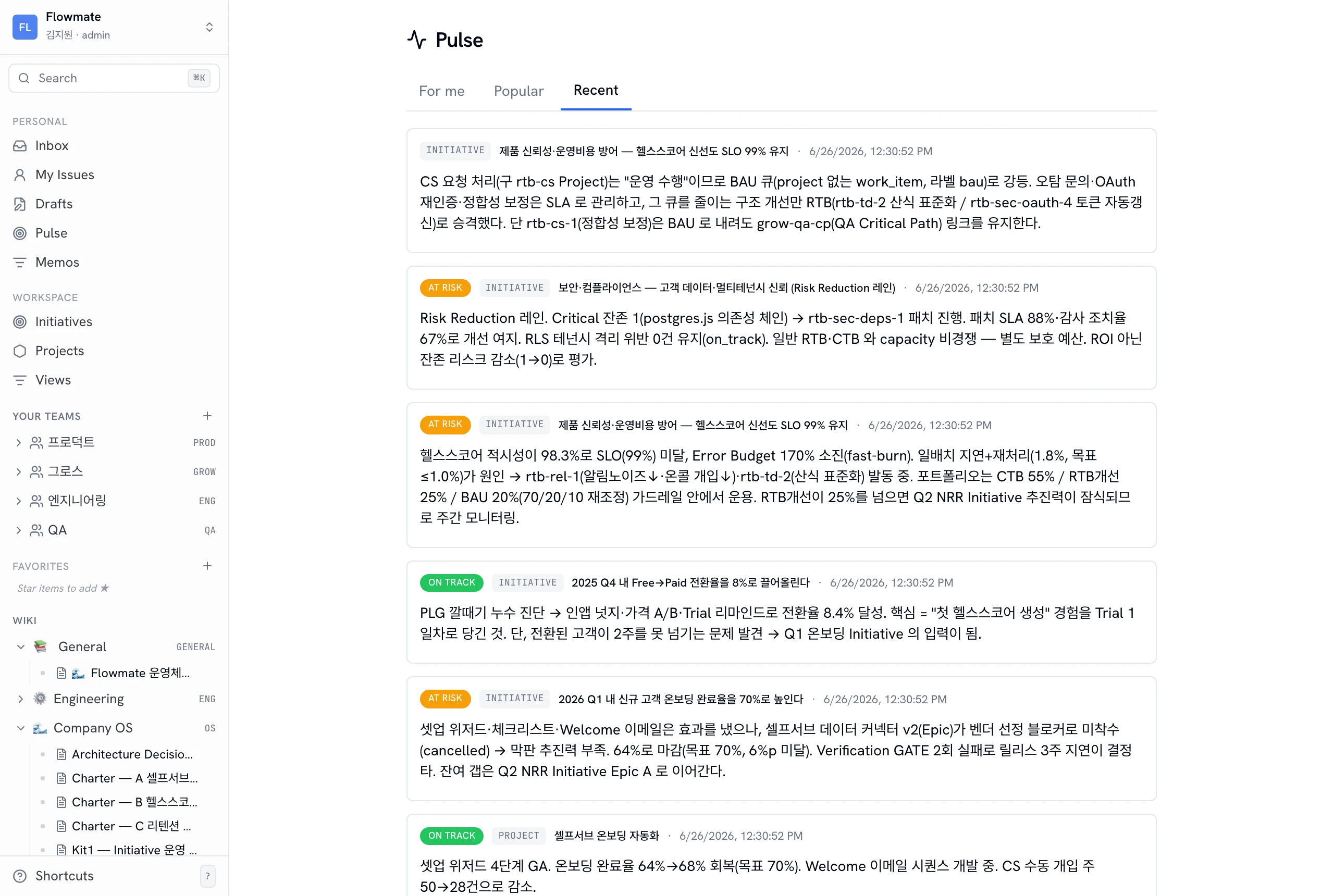
Work comes from goals, the reasons and decisions behind it live in documents, and results are verified by metrics. A verified result becomes the next goal. Issues, docs, and metrics link to each other and close into a single loop.
-
Pulse feed
Changes across all three services flow into one timeline, each with its source. Click a card to jump to the original.
-
Cross-link
Issues, docs, and metrics reference one another. Jump straight from an issue to a doc, from a doc to a metric.
-
Unified search
Find issues, docs, and metrics in a single search.
Issue Tracking
Connect execution
to the goal
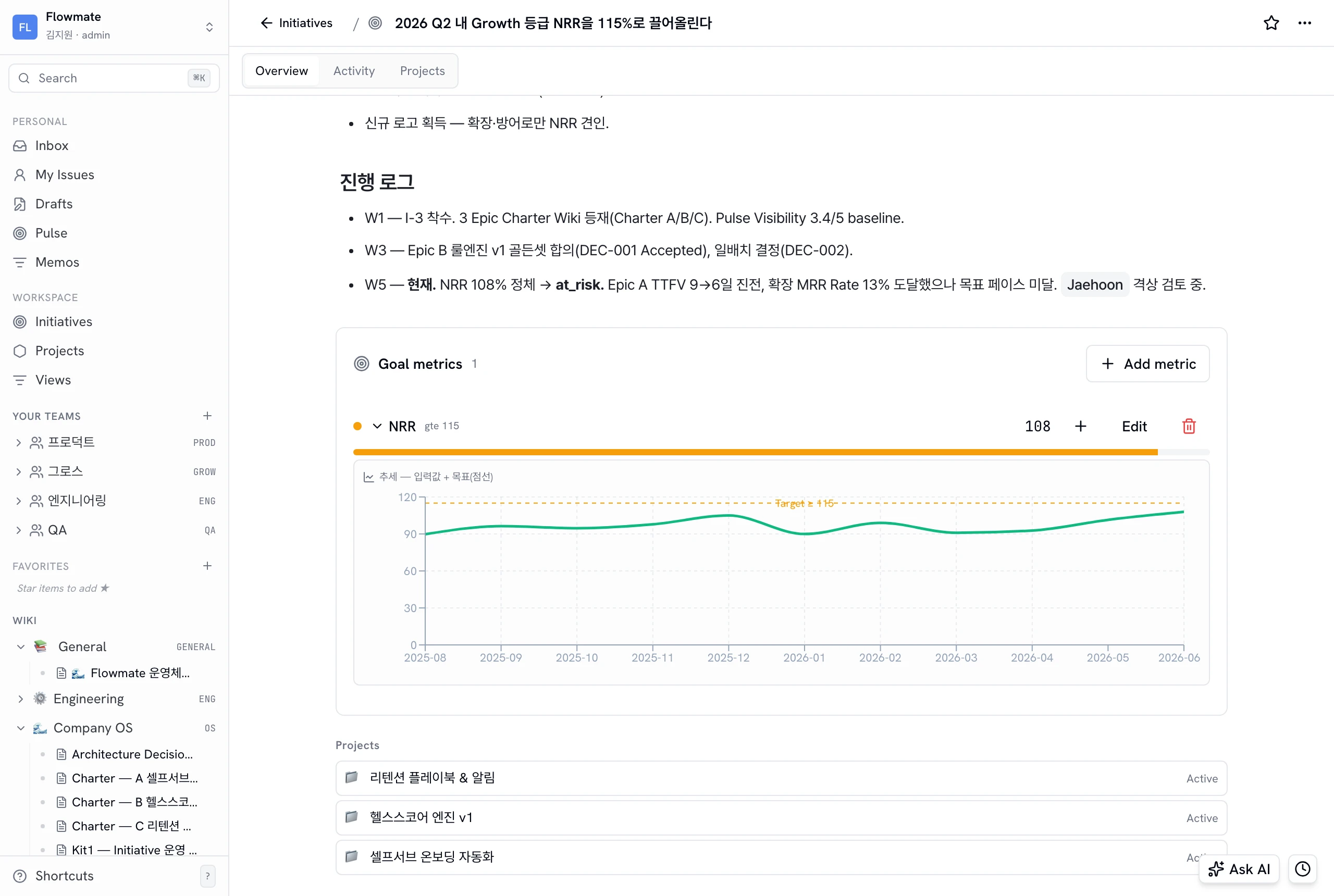
You can always see which goal your current work rolls up to. Link a goal metric to an Initiative, and execution progress is measured directly as goal attainment.
-
Initiative → Project → Issue
Every single issue ladders up through the hierarchy to the quarter's goal.
-
Track attainment with GoalMetric
Link a metric to an Initiative and see, in numbers, how close execution is to the goal. (e.g. NRR at 108% against a 115% target.)
-
List · Board · Tree · Calendar
See the same issues in four views, and save frequent filters as a View for the team to reuse.
-
Automatic Milestone rollups
No more hand-built progress reports — projects roll up on their own.
Wiki
Where decisions and context
don't evaporate
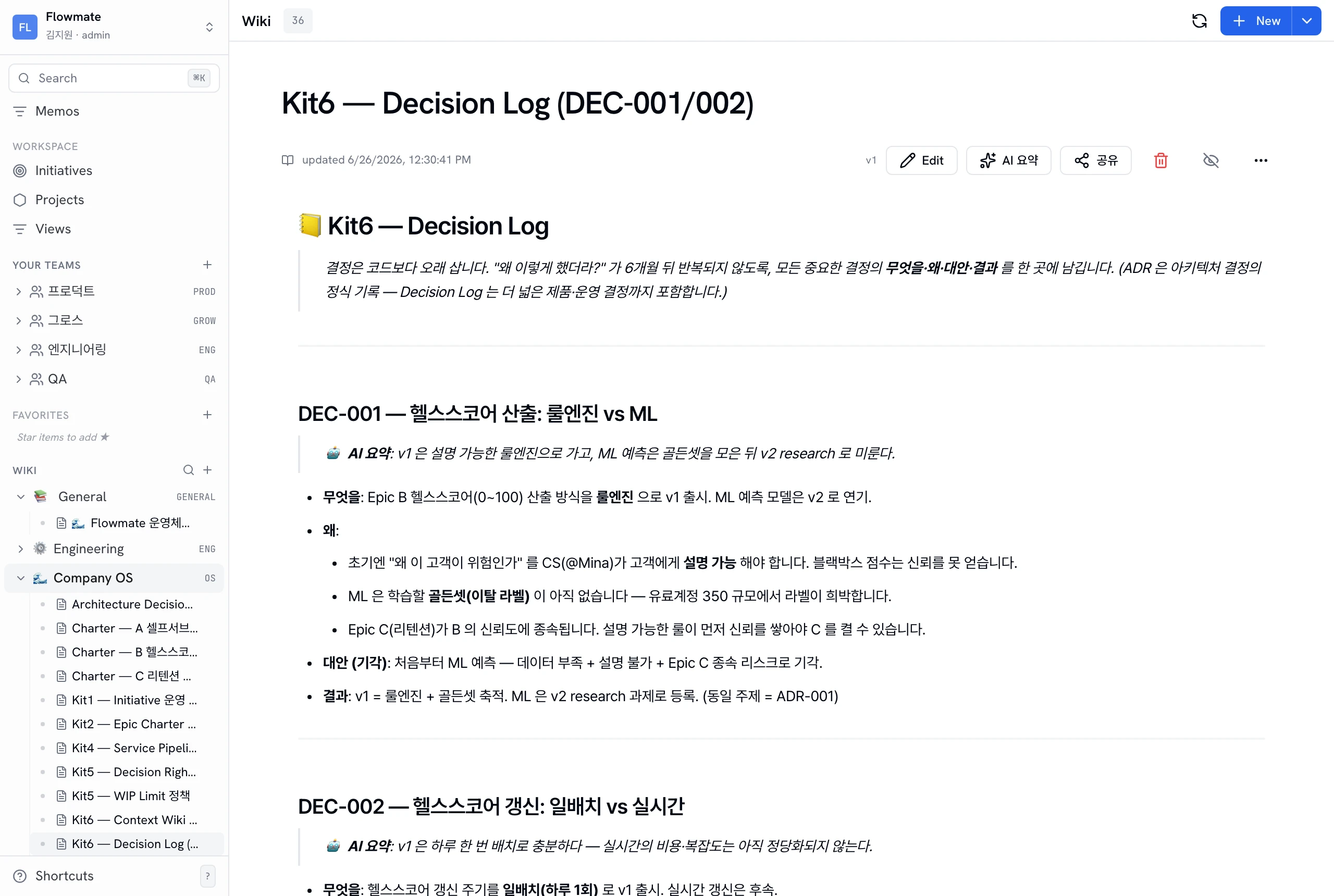
Organizations that ‘decide, then decide again’ lack a single source of truth. Decision logs, a context wiki, and onboarding docs accumulate in one place. The same document is a single source of truth for people and a context layer for AI.
-
Block editor
Documents, tables, and images, freely composed — with typography tuned to read well even when Korean and English mix.
-
Inline comments · highlights
Highlight down to the sentence and discuss right there. Review context is never lost.
-
Spaces & page trees
Partition knowledge by team and topic, and navigate it straight from the sidebar.
-
Version history · AI summaries
Compare and restore revisions. Long documents get summarized by AI.
Goal BI
Status against goals,
in numbers, not hunches
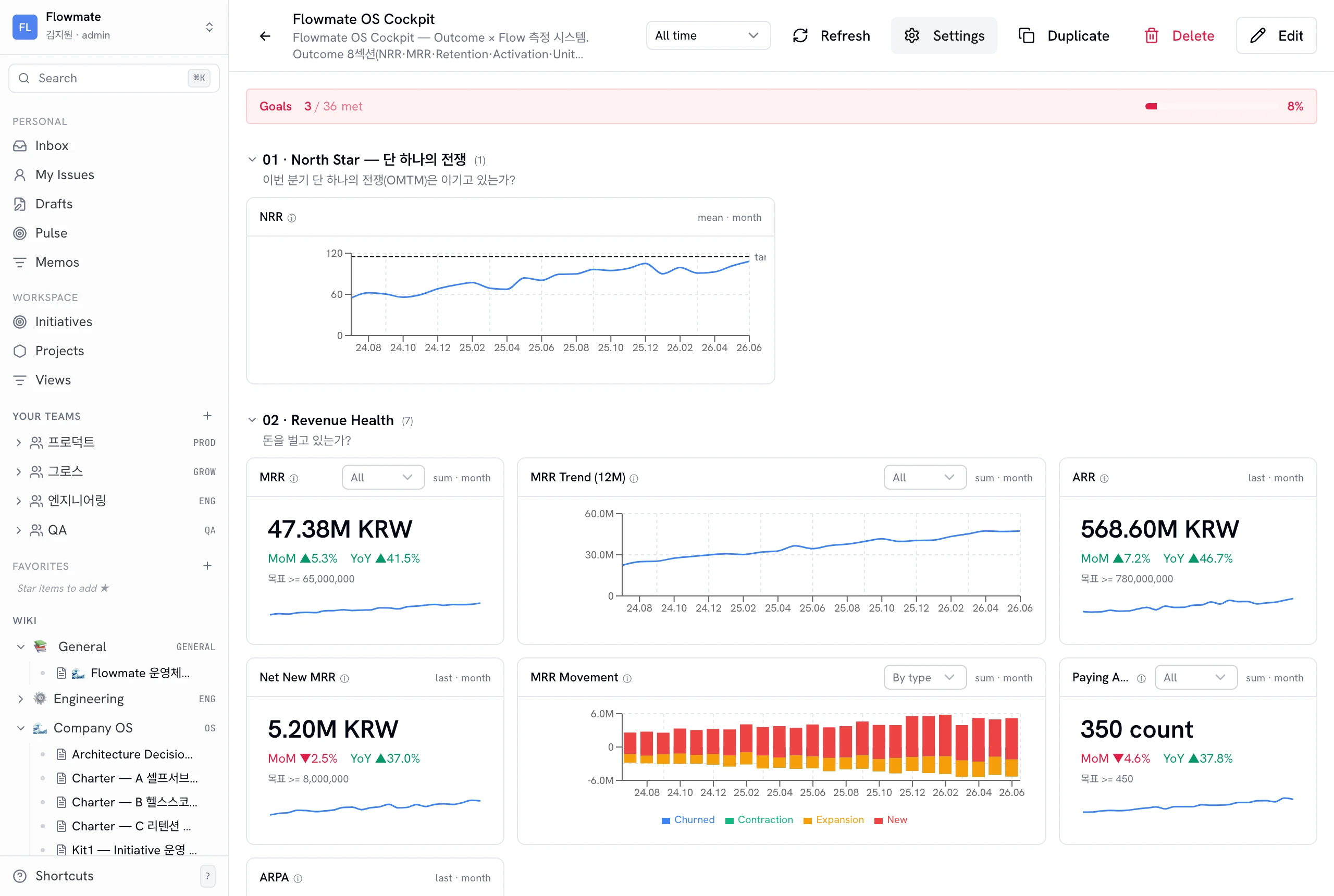
A goal isn't finished when it's declared; it becomes a standard when a metric verifies it. So that ‘are we on track?’ is answered with data instead of opinion, GoalTrack draws the goal line on every chart.
-
One metric engine, two perspectives
Growth metrics (GoalMetric) and operational reliability metrics (SLO), measured in the same language.
-
Dashboard builder with 9 widgets
KPI, line, gauge, funnel. Build the dashboard your team needs, and drill from a widget straight to the source metric.
-
Automatic Analytics
Throughput and cycle time roll up automatically from issue data. The product measures your team's execution speed on its own.
-
Spreadsheet-style data editing
Enter metric values like a spreadsheet, and slice them by dimensions such as channel and plan.
AI Collaboration
An AI collaborator
that works like a teammate
Here, AI isn't a side feature — it's a worker operating in the same environment as people. The real difference isn't that ‘there's an AI feature.’ It's that the product itself is built to be delegated to. That structure — where goals are recorded, decisions are kept, and definitions of done are agreed — is opened up through MCP across 18 domains.
18 domains, opened via MCP
With 58 MCP tools, an AI agent creates issues, writes docs, and records metrics through the same interface people use. Every action passes the same validation and lands in the same history.
AI as the assignee
Assign AI as an issue's owner (AI Assignee). It carries out the delegated work and reports back in a comment.
Away-time summaries
AI summarizes what changed while you were away, right in your Inbox. No opening notifications one by one.
Natural-language commands
You don't need to know feature names. Tell Cmd+K what you want to do, and it happens.
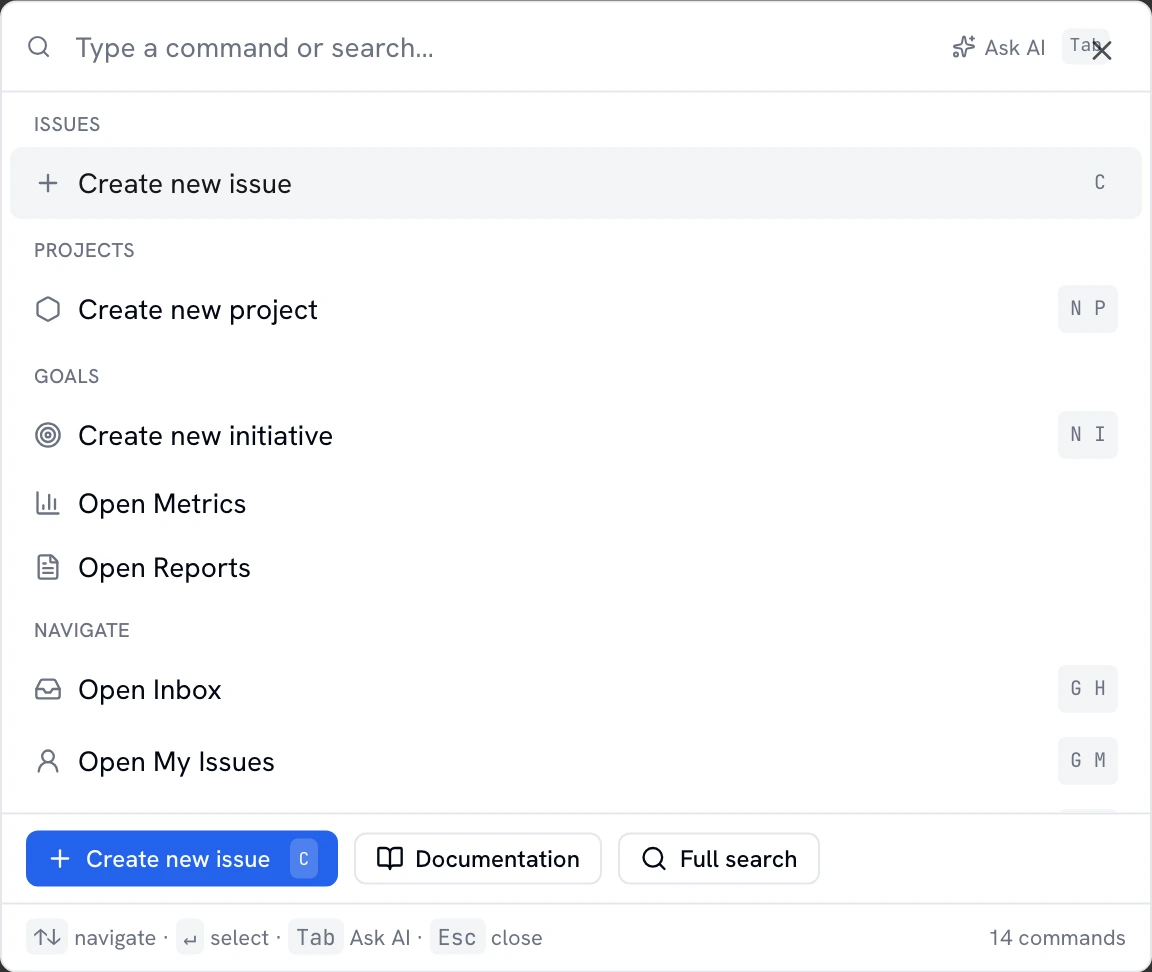
What a person does through the palette, AI does the same through MCP.
Work without a goal scatters,
work without context repeats,
work without proof
never improves.
Issues are the work. Wiki is the context. Metrics are the proof.
Humans and AI
agents work from the same baseline.
Pricing
Core is free.
Only AI collaboration is metered
Goal management, issue tracking, wiki, BI — everything at the core of team collaboration is free. AI collaboration is billed per workspace, by the token, only for what you use.
Core · Free
Free
Whole team, no feature locks
- Goal management — Initiative · GoalMetric · Milestone
- Issue tracking — List · Board · Tree · Calendar views
- Wiki — block editor · inline comments · version history
- BI — goal-line dashboards · automatic reports
AI collaboration · Usage-based
$3/ 1M input tokens
Per workspace · $15 per 1M output tokens · pay as you go
- MCP across 18 domains · 58 tools
- AI Assignee — assign AI as an issue owner
- AI away-time summaries (Inbox)
- Cmd+K natural-language commands
Issues · Wiki · Goals · BI are free, always. AI collaboration is per workspace, only for what you use.
FAQ
Frequently asked
If you already run another tool, these come up first.
Can GoalTrack replace Jira or Linear?
It covers the core of issue tracking: an Initiative · Project · Issue hierarchy, List · Board · Tree · Calendar views, status, priority, assignee, labels and milestones, and keyboard-first navigation. You can import existing issues from Linear (CSV or API) and Jira (CSV), so you can move a copy over and judge for yourself. What it does not replace is Jira’s fine-grained workflow engine or its marketplace app ecosystem.
Is there a wiki like Confluence?
Yes. Spaces and page trees, a block editor, inline comments and highlights, version history, and per-space access control. You can import existing pages from a Confluence space export (ZIP). It is not a separate subscription — it lives in the same workspace as your issues and metrics, so a document can link to the work and an issue can point back to the decision that produced it.
How does goal and OKR tracking work?
Attach a GoalMetric to an Initiative and the execution progress of its issues becomes the goal’s attainment. You do not keep a separate OKR spreadsheet in sync, because execution and goals are measured from the same data. Every chart draws the target line next to the actual line.
Can I bring data over from the tools I already use?
Linear via CSV export or an API key, Jira via CSV export, and Confluence via a space export ZIP. Import runs in two phases: you preview exactly what will come in, then commit. GoalTrack also exports your workspace as a ZIP, so you can always take your data back out.
Is it really free?
Issue tracking, the wiki, goal tracking and BI are free with no seat limits and no feature locks. The only thing billed separately is AI collaboration, charged per workspace for the tokens you actually use.
How do AI agents work alongside the team?
AI uses the same interface people do. MCP exposes 58 tools across 18 domains, so an agent can create issues, write documents and record metrics. You can also assign an issue to an AI. Whether a person or an agent does the work, it passes the same permission checks and leaves the same history.
Start building a goal-driven team,
today
Your workspace opens the moment you sign up. Invite your team and define this quarter's goal.